Topic 6: Performance and Scalabilitys
Goal:
Explain how to increase the performance of Java code using threading.
Illustrate some of the pitfalls there are in doing this.
Java Executors - Tasks
Tasks are a central concept for executors
- When designing a program using executors, first think about the tasks to be executed
- Like for threads, tasks can be conveniently defined in their own class
- Ideally, tasks should be independent (if not, thread satefty must be ensured)
@Override
    public void run() {
        if ((high-low) < threshold) {
            for (int i=low; i<=high; i++) if (isPrime(i)) lc.increment();
        } else {
            int mid= low+(high-low)/2;
            Future<?> f1 = pool.submit(new countPrimesTask(lc, low, mid, pool, threshold) );
            Future<?> f2 = pool.submit(new countPrimesTask(lc, mid+1, high, pool, threshold) );

            try { f1.get();f2.get(); }
            catch (InterruptedException | ExecutionException e) { }
    }
}


class PrimeCounter {
  private int count= 0;
  public synchronized void increment() {
      count= count + 1;
  }
  public synchronized int get() {
      return count;
  }
  public synchronized void setZero() {
      count= 0;
  }
}
initializes the Executor service
class PrimeCountExecutor {
      private ExecutorService pool;
      ...
      public PrimeCountExecutor () {
            pool= new ForkJoinPool();
            Future<?> done= pool.submit(new countPrimesTask( ... ));
            try { done.get(); }
      }
  }

  // pool= new ForkJoinPool( n );
  // n specifies the number of CPUs that will be used
The ExecutorService can be shut down.
pool.shutdown();- After shutdown the pool cannot be reused, but can assign it a new value
Runnable vs. Callable
- Both are used to specify the code of a thread
- Runnable
- cannot return a result
- overrides run()
- Callable
- returns a result (via a Future)
- overrides call()
- Runnables may use shared data (e.g., to deliver a result , in countPrimes example), callable can also use shared data.
public class DotProductTask implements Callable<Integer> { final int pos; final int[] x, y; public DotProductTask(int[] x, int[] y, int pos) { this.x = x; this.y = y; this.pos = pos; } @Override public Integer call() { return x[pos] * y[pos]; } }List<DotProductTask> tasks = new ArrayList<DotProductTask>(); // Randomly initialize arrays x and y... // Create the list of tasks (Futures) to execute for (int i = 0; i < N; i++) tasks.add(new DotProductTask(x,y,i)); ... // Add all futures to the execution pool at once List<Future<Integer>> futures = pool.invokeAll(tasks); for(Future<Integer> f : futures) { result += f.get(); // Wait for each future to be executed pool.shutdown();Submit vs Execute
- Both are used to spawn a tasks
- pool.execute
- cannot return a result
- pool.submit
- returns a result (via a Future)
Scalability, speed-up and loss (of scalablity) classifications
Quicksort executor
class QuicksortTask implements Runnable {
      Task p; // low and high boundaries
      ExecutorService pool;

      @Override public void run() { qsort(p, pool, ... ); }

      public static void qsort(Task p, ExecutorService pool, ...
      ) {
            Future<?> lowTask= null; Future<?> highTask= null;

            //split task in two: Low and High
            if (Low.size>= threshold)
                  lowTask = pool.submit( new QuicksortTask( pLow, pool, ... ))
            else
                  Quicksort(pLow); //sequential sort
            if (High.size>= threshold)
                  highTask = pool.submit( new QuicksortTask( pHigh, pool, ... ))
            else
                  Quicksort(pHigh);
 }

 //Waiting for longest running subtask to finish
try {
        lowTask.get();
        highTask.get();
} catch (InterruptedException | ExecutionException e) { e.printStackTrace(); }
- Sorting results (Does not scale perfectly)
Executor
1 8.5 s
2 4.8 s
4 2.6 s
8 2.2 s
16 2.2 s - Loss of scalability
- Starvation loss
- QuickSort (第一阶段划分数组时只用了一个cpu横扫)
- Minimize the time that the task pool is empty
- Separation loss (best threshold)
- Prime count
- Find a good threshold to distribute workload evenly
- Saturation loss (locking common data structure)
- Minimize high thread contention in the problem
- Braking loss
- String search
- Stop all tasks as soon as the problem is solved
- Starvation loss
- What limits performance
- CPU-bound
- Eg. counting prime numbers, sorting, ….
- To speed up, add more CPUs (cores) (exploitation)
- Input/output-bound
- Eg. I/O or reading from network
- To speed up, use more threads/tasks (inherent)
- Synchronization-bound (Saturation loss)
- Eg. Algorithm using shared data structure
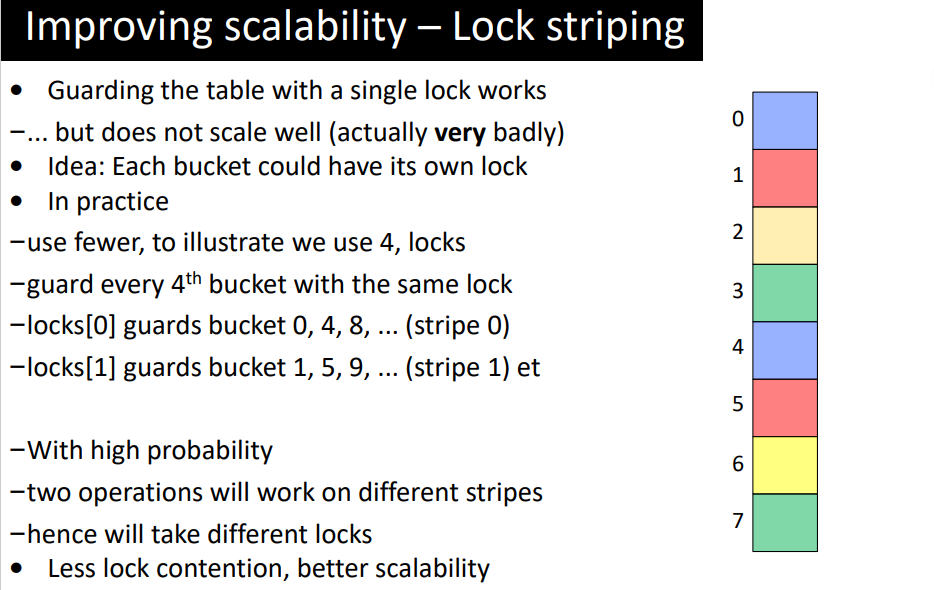
- To speed up, improve shared data structure (eg. Lock striping)
- CPU-bound
Lock striping